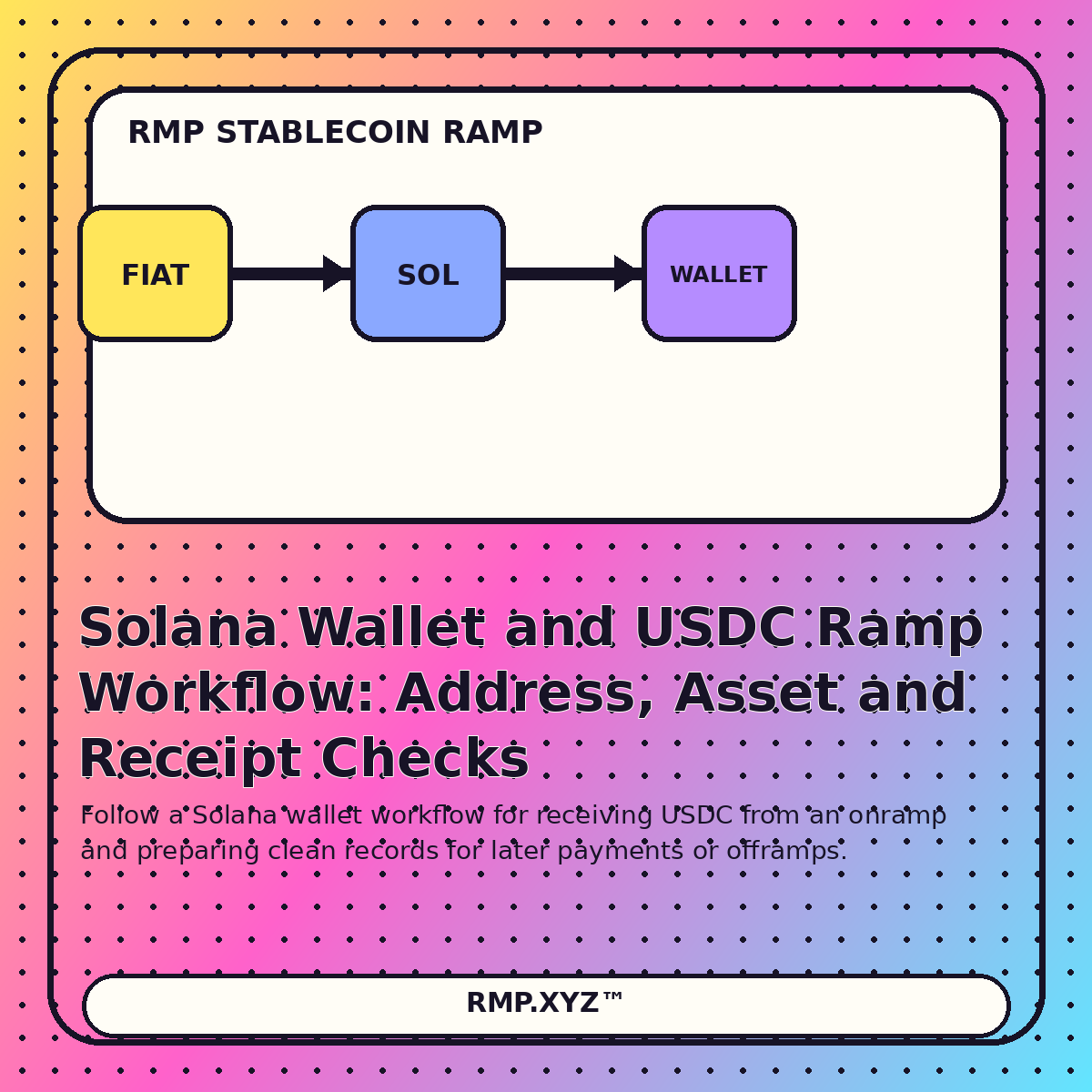
A reliable Solana wallet ramp workflow separates three decisions: who controls the wallet, which Solana address receives the funds and which USDC asset the provider will deliver. Each decision should be confirmed before payment is authorized.
Start with the destination, not the button
A useful Solana wallet ramp workflow begins by defining the final outcome. In this route, the value starts with fiat-funded USDC purchase and should finish at a verified Solana wallet balance. That destination determines the supported USDC on Solana, the required Solana, the wallet or beneficiary details and the evidence needed to prove completion.
Fast settlement reduces waiting, but it also leaves less time to catch a wrong address. A short preflight checklist is more valuable than attempting to reverse an irreversible transfer. The route should therefore be reviewed as a connected system rather than a sequence of unrelated screens. A low fee at the first step has little value when the destination cannot accept the asset or when a later conversion adds cost and delay.
Map the full transaction flow
Write the route in plain language before authorizing it: establish eligibility, complete required verification, choose a funding or deposit method, review the quote, confirm the exact asset and network, verify the wallet or beneficiary, execute the transfer and reconcile the final result. Each stage should have an owner and a status that can be understood without interpreting blockchain jargon.
For Solana wallet ramp workflow, the critical handoff is between fiat-funded USDC purchase and a verified Solana wallet balance. The user should know when the quote becomes final, when a transaction can no longer be cancelled, how many confirmations are required and what information support will need if settlement is delayed.
Compare providers and routes by net outcome
Use address copy tools carefully, verify the beginning and ending characters, confirm that the wallet is on Solana, save the provider receipt and record the transaction signature.
Use the same starting amount when comparing alternatives. Record every explicit fee, exchange-rate spread, network charge, payment-method cost and payout deduction. The comparison should end with the net USDC on Solana or fiat amount delivered, not with a marketing percentage that may exclude other costs.
Liquidity also matters. Larger transactions can receive a different effective rate than small transactions, and weekend or holiday banking schedules can affect the final payout even when blockchain settlement is complete. Capture quote time and expiry so a later comparison remains meaningful.
Route comparison fields
| Field | What to capture | Why it matters |
|---|---|---|
| Asset + network | USDC on Solana on Solana | Prevents incompatible delivery or deposit. |
| All-in price | Fees, spread, network and payout charges | Shows the true delivered value. |
| Timing | Quote, confirmation and bank windows | Separates blockchain speed from payout speed. |
| Evidence | Order, receipt, hash and settlement record | Supports reconciliation and dispute review. |
Verify asset, network, wallet and beneficiary
The token symbol alone is not enough. Confirm USDC on Solana on Solana, then confirm that the destination supports that exact combination. Wallet addresses should be copied through trusted interfaces and checked again before authorization. For bank settlement, the beneficiary should match the verified account unless the provider explicitly supports another arrangement.
A strong workflow displays the network at every decision point, validates address format where possible and produces a final review screen. Businesses can add allowlists, dual review, transaction limits and saved beneficiary records to reduce repeated manual risk.
Plan for compliance and exceptions
Stablecoin ramps commonly include identity checks, sanctions screening, transaction monitoring and requests for source-of-funds or business-purpose evidence. These controls can be triggered by jurisdiction, amount, payment method, wallet history or transaction pattern. Users should provide accurate, consistent information and avoid sending funds from unrelated third parties.
Address poisoning, copied-address malware, unsupported wallet custody, hidden token accounts and confusion between multiple USDC representations can undermine the workflow. Before beginning, locate the provider’s minimum amount, refund policy, unsupported-deposit policy, document-request process and support channel. Never disclose a seed phrase or private key to a provider or support agent.
Measure the route after settlement
A completed transaction should produce a compact evidence set: quote or order reference, payment receipt or deposit instructions, blockchain transaction hash when applicable, conversion record, payout confirmation and the final wallet or bank amount. This evidence supports accounting, tax records, customer support and future route comparison.
Useful operating metrics for this route include address verification completed, USDC balance received, transaction signature recorded, provider receipt retained, wallet backup tested. Tracking these measures over time reveals whether the selected route remains reliable as fees, liquidity, network conditions and banking availability change.
Implementation checklist
1Before using Solana wallet ramp workflow, confirm eligibility, the payment or deposit source, USDC on Solana, Solana, destination compatibility, all-in cost, quote expiration, transaction limits, expected timing, compliance requirements and the exception process.
2During the transaction, use only the instructions shown for the active order, verify addresses and beneficiary details, retain transaction evidence and avoid opening duplicate orders when a transfer appears delayed.
3After settlement, compare the amount actually delivered with the quote, label the transaction in the wallet or accounting system, close any unnecessary token approvals and record lessons for the next route.
Key takeaways
- Define the destination and required USDC on Solana route before funding.
- Compare net delivered value and total completion time.
- Verify the network, wallet address or bank beneficiary.
- Retain the quote, receipt, transaction hash and settlement evidence.
- Use documented compliance and exception procedures.
Questions about this route
What is the main purpose of Solana wallet ramp workflow?
It connects fiat-funded USDC purchase with a verified Solana wallet balance using USDC on Solana and the supported Solana route.
What should be verified before using this route?
Verify eligibility, the exact asset and network, wallet or beneficiary details, all-in pricing, limits, expected timing and the provider’s process for exceptions.
Can a completed blockchain transfer be reversed?
Generally, a valid blockchain transfer cannot be reversed by the sender. Users should verify the destination and network before signing or authorizing the transaction.
Editorial note: This guide is educational and does not recommend a specific provider or transaction. Availability, fees, limits, asset support and legal requirements can change.